

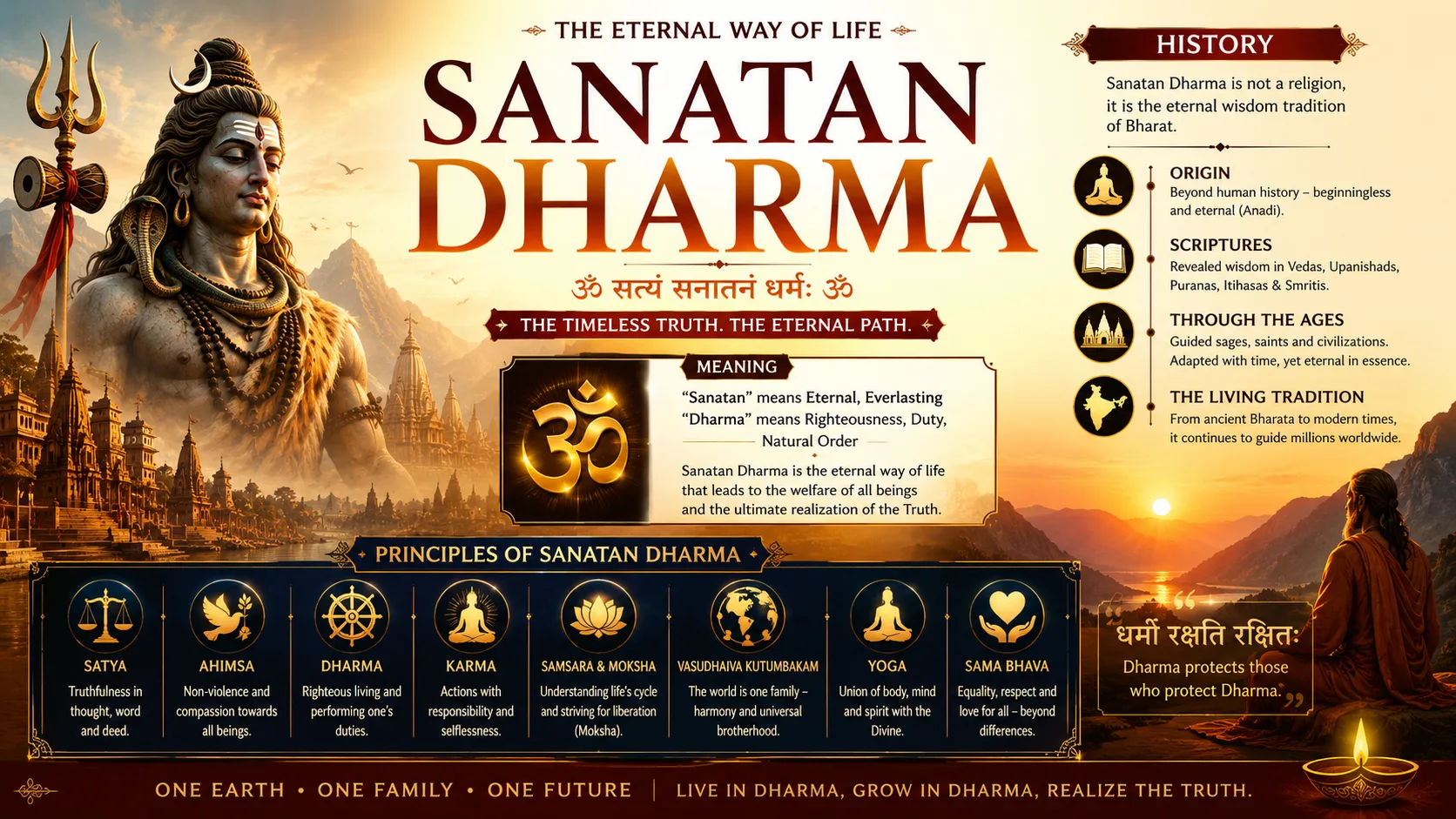
If you have ever asked a Hindu elder about their religion, most likely you would get a surprising reply like, We don’t label it as Hinduism, we refer to it as Sanatan Dharma.
About 1 million and more persons, for them, this is not a mere religious identification.
- It’s a way of understanding existence itself. But what is Sanatan Dharma, really?
- Is it a religion, a philosophy, or something far bigger than both?
This guide breaks down the true meaning, origin, and living principles of Sanatan Dharma – explained simply, for anyone curious about India’s oldest spiritual tradition.
- The True Meaning of Sanatan Dharma
- Breaking Down the Word Sanatan
- Understanding Dharma Beyond Religion
- Sanatan Dharma vs Hinduism Are They the Same?
- The Ancient Origin of Sanatan Dharma
- Core Principles of Sanatan Dharma
- The Ancient Origins of Sanatan Dharma
- Vedic Roots and Timeless Wisdom
- Why It Has No Founder or Start Date
- Core Principles of Sanatan Dharma
- Dharma (Righteous Duty)
- Karma (Law of Action)
- Moksha (Liberation)
- Ahisma (Non-Violence)
- Seva (Truth)
- Rewarding The Four Ways | Purushartha
- Holy Writings of Sanatan Dharma
- 16 Sanskars the Life Journey of Sanatan Dharma
- Sanatan Dharma in Our Everyday Lives Today
- The Reasons Sanatan Dharma is Called The Eternally Unchanging Way
The True Meaning of Sanatan Dharma
The word Sanatan Dharma is a composite of two Sanskrit words, and getting the meanings of its two roots is essential to grasping the philosophy in its entirety.
Breaking Down the Word Sanatan
Sanatan (सनातन) stands for eternal, timeless, or without a start or end. It doesn’t mean something old that has had a long life; it describes something that never was created and never will be destroyed, similar to the laws of physics such as gravity and the seasonal cycles.
Understanding Dharma Beyond Religion
Dharma (धर्म) is often mistakenly translated simply as religion, while in fact its genuine sense is much broader and deeper.
The concept of dharma encompasses an individual’s righteous duty, the natural order, moral law, and the way of existence that ensures harmony in the universe and in one’s personal life.
It is as if a river’s dharma is to carry its waters forward. A fire’s dharma is to provide warmth and flame through the process of burning.
A human being’s dharma is to live truthfully, act righteously and serve one’s family, society, and cosmos by doing their duty towards all of these.
Put together, Sanatan Dharma means the eternal natural order or the timeless path of righteous living. It is less a religion with fixed rules and more a universal framework for how to live in harmony with truth.
Sanatan Dharma vs Hinduism Are They the Same?
This is one of the most common questions people ask – and the answer matters.
The word Hindu was historically a geographical term, used by Persians and later the British to describe people living beyond the Sindhu (Indus) River.
Combined, Sanatan Dharma translates to the natural/eternal order or the path of eternal/righteous living.
In time it became the name of a collection of spiritual traditions of different kinds that originated in the Indian subcontinent.
Later, this name evolved into being known as Hinduism in the modern English language.
Nevertheless, Sanatan Dharma is the term by which people involved in this tradition themselves have been known as for millennia.
It is the term to be found in ancient texts and it is an indication of something which the use of the term Hinduism as an outside label often leaves out that this is not one organized religion having a single founder or holy book but rather an eternal, evolving tradition of philosophy, practice, and self-realization.
In view of all these factors, although today, the two terms are more or less considered as being one, Sanatan Dharma reveals that this is the spiritual tradition at the depth level which its followers identify and characterize the why behind the what of this spiritual path.
The Ancient Origin of Sanatan Dharma
Sanatan Dharma finds its source in the Vedas, the world’s most ancient spiritual texts, which the ancients authored and passed on only verbally for thousands of years.
Whereas other world faiths claim their scriptures were revealed to a single individual prophet at one fixed spot and time, Sanatan Dharma regards the Vedas as Shruti, what the ears hear, eternal wisdom revealed to the ancient sages (rishis) through meditation alone deep.
Reason for its Founder less or Dateless Features Probably the most unique characteristic of Sanatan Dharma is that it lacks a single founder, or even a one holy book.
It also has not got a definite founding date.
Sanatan Dharma is different from Buddhism (buddha), Christianity (Jesus), as these are revealed through one prophet. While Sanatan Dharma has no founder and is founder less, it grew through a long history of many sages, philosophers and spiritual teachers sharing, adding, and recording their wisdom.
This is exactly why it’s called Sanatan – eternal. It doesn’t have a beginning because, according to its own philosophy, truth itself has no beginning.
Core Principles of Sanatan Dharma
While Sanatan Dharma embraces immense diversity in practice, several core principles run through nearly all its schools of thought.
The Ancient Origins of Sanatan Dharma
Vedic Roots and Timeless Wisdom
The roots of Sanatan Dharma lead back to the Vedas which are amongst the earliest spiritual scriptures of the mankind dated back to a period of the composers and the oral transmitters thousands of years ago.
However, Sanatan Dharma differentiates itself as it does not say that these scriptures were revealed at once through a single individual by God.
Rather these texts are considered to be the Shruti literally means what is heard the eternal knowledge was perceived by the ancient rishis (sages) in their profound meditative states.
Why It Has No Founder or Start Date
This may be the most unique quality of Sanatan Dharma : There is no founder, single religious book nor a fixed founding date.
While Buddhism (Buddha), Christianity (Jesus Christ), Sanatan Dharma was a gradual growth spanning millennia which was fueled mainly by the wisdom of the great number of sages, philosophers and spiritual masters accumulated over this long period.
This is exactly why it’s called Sanatan – eternal. It doesn’t have a beginning because, according to its own philosophy, truth itself has no beginning.
Core Principles of Sanatan Dharma
While Sanatan Dharma embraces immense diversity in practice, several core principles run through nearly all its schools of thought.
Dharma (Righteous Duty)
Living true to one’s nature and responsibilities, such as a father, student, teacher, worker, or citizen while also maintaining the truth and moral order of the world.
Karma (Law of Action)
You get back what you give, the consequence of every action, which could happen now or later. This teaching fosters the ideas of responsibility and careful awareness as your present position is due to your past karma.
Moksha (Liberation)
The most important goal in the spiritual domain, the liberation of an individual after he or she stops being reborn. This state is achieved when the seeker attains realization that he is none other than the Supreme consciousness itself (Brahman).
Ahisma (Non-Violence)
Not causing any harm even mentally, verbally or physically, the principle applies to every form of living creature. Its influence goes far beyond a mere act of religion. Mahatma Gandhi, in particular, used it to promote peace in the international arena as well.
Seva (Truth)
Being sincere is the virtue of being right in thought, speech and action. This kind of person is considered to be a model citizen.
Rewarding The Four Ways | Purushartha
Sanatan Dharma teaches that there are four human life pursuits which it calls the Purushartha :
- Dharma, righteous living and performing one’s duties
-
Artha, the pursuit of riches and physical comfort in an ethical and just way
-
Kama, the gratification and pleasures of desires and the satisfaction of emotional desires
-
Moksha, the attainment of spiritual freedom, which is the ultimate state
If one religious tradition is a kind of asceticism, then Sanatan Dharma may be a kind of harmony of both, in teaching that if material and sexual life are in harmony with dharma, then one can reach moksha.
Holy Writings of Sanatan Dharma
Sanatan Dharma does not have one single sacred book, rather it includes a great number of sacred books that mainly fall under two broad groups.
-
The Shruti (what is heard), such as the four Vedas (Rig, Yajur, Sama, and Atharva) and the Upanishads.
-
The Smriti (what is remembered/composed) include Bhagavad Gita, Ramayana, Mahabharata, and the Puranas.
Among all the scriptures of Sanatan Dharma, the Bhagavad Gita is the most well-known, providing the seeker with a short spiritual dialogue on duty, action, and devotion with a practical outlook that will not disappoint anyone.
16 Sanskars the Life Journey of Sanatan Dharma
Sanatan Dharma offers a detailed life plan to its adherents through the 16 Sanskars (Shodasha Sanskara), sacred ceremonies or rites held at different stages of life from conception to death, the aim of which is to cleanse the individual and guide him/her throughout every important stage in life including conception, birth, naming, feeding of the baby, initiation to study, marriage, last rites, etc.
(Check our dedicated Sanatan Dharma pillar guide for a full breakdown of the 16 Sanskars)
Sanatan Dharma in Our Everyday Lives Today
For countless practitioners, everyday life is suffused with Sanatan Dharma from getting up in the morning with prayers, puja or offering to the divine, through yoga and meditation, food choices (e.g., vegetarian diet) based on non-violence (ahimsa), respect to elders and gurus, traditional festivals celebrating natural cycles (Navratri, Diwali etc.), and pilgrimages to sites holding sacred power that give inspiration.
The presence of Sanatan Dharma in life day-by-day justifies the description of it not being a one-week-a-week religion but rather a total way of life.
The Reasons Sanatan Dharma is Called The Eternally Unchanging Way
The following factors, among others, are three key reasons :
- It has no definite chronological beginning, the wisdom that came from Sanatan Dharma is believed to be as ancient as time.
-
It teaches universal and nature laws like dharma and karma. It portrays them as cosmic phenomena not human legislations or rules.
-
It adapts in harmony with new trends while retaining the original message saints, saints’ movements, and different interpretations in various ages still keep the same truth. So, Sanatan Dharma’s core message, its soul, remains the same forever.
Sanatan Dharma is distinct compared to religious belief systems that are tied to specific prophetic moments and/or a single historical event.
Sanatan Dharma sees itself as an explanation of reality that is not limited or dependent on any given moment in time. Thus, it should not be surprised that one of the names of Sanatan Dharma is Eternally Unchanging Way.
FAQ’s
Q1: Sanatan Dharma vs. Hinduism?
In short, Hinduism and Sanatan Dharma are similar but different. Sanatan Dharma is the self-chosen, philosophical name for the tradition, focusing on its eternal and dharma-centered character. Whereas “Hinduism” was coined as an external, geographic name.
Q2: Who is the founder of Sanatan Dharma?
No one person is recognized as the founder. It is wisdom perceived by ancient sages over centuries, which makes it one of the ancient religions without a definite founder or an assigned starting date.
Q3: Which are the main beliefs of Sanatan Dharma or Hinduism?
One can say the main teachings are dharma (meaning righteousness and what is one’s own), karma (the rule of action and reaction), moksha (the soul being free from the cycle of birth and death), the belief in all life as divine beings (atman and the Brahman), and the pursuit of satya (truthfulness) and ahimsa (non-violence) that are part of the great vows in Hinduism.
Q4: What do they call the holy book of Sanatan Dharma?
There is no exclusive holy book of Sanatan Dharma. Main texts are the four Vedas, the Upanishads, the Bhagavad Gita, the Ramayana, and the Mahabharata.
Q5: What is the meaning that it’s called Sanatan?
In general, Sanskrit, Sanatan means eternal or timeless, that the laws behind it are considered eternal truths rather than temporary teachings created at a specific time in history.




Join the Discussion
Loading discussion...